


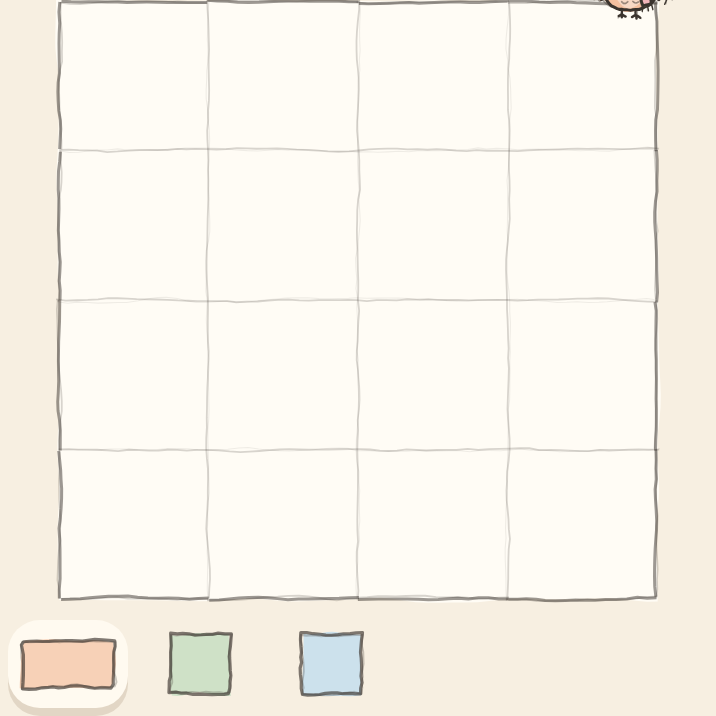
One hint
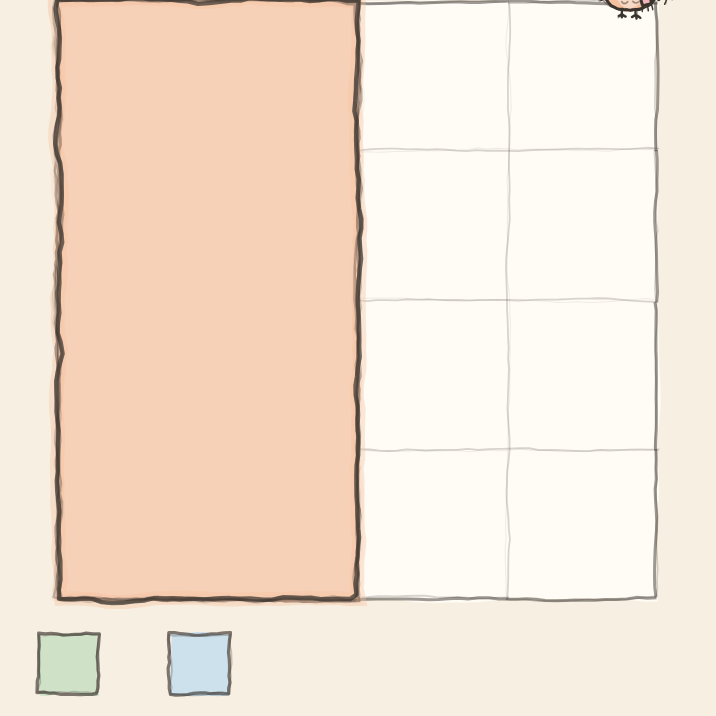
The game shows one next step.
Look at the gaps
Put a piece inside the outline without overlap. Then look at the empty space. Can the pieces left still fill it? Start with the smallest gaps.
One joined piece cannot fill two gaps split by other pieces. Each gap needs whole pieces that add up to its size. Counting all the empty space at once is not enough.
A small gap can stop the whole fit
Suppose only pieces of two joined squares are left. Such a piece is called a domino. One lone empty square cannot hold it. The total empty space might be right, but that tiny gap is still wrong.
Turning a domino will not fill a lone square. It would hit another piece or leave the outline. Change an earlier piece beside the gap.
Count, then check the shape
If every piece left has pairs of squares, a gap of odd size cannot work. For example, two-square pieces cannot fill a one-square gap. If pieces of sizes 3 and 5 remain, they cannot fill two separate gaps of size 4.
The count can be right while the shape is wrong. A four-square piece may not match a four-square gap. Check corners and narrow spaces next. On Nimo's polygon boards, use the real shape edges and sizes. The square-count trick is for square tiles.
A turn is not a flip
Turning moves the same shape round. Flipping makes its mirror image. Some bent or zigzag pieces need a flip to fit a mirror-shaped gap. More turns will not make that mirror.
Use a flip only where the pack allows it. A square looks the same after a turn. Moving its place, rather than turning it again, may give a new fit.
Use the moves your pack allows
Nimo Shapes has Fixed packs. Those pieces keep their first direction. In rotating polygon packs, coloured pieces can use allowed turns or flips. Iron blue-gray pieces only slide. Do not plan to turn an iron piece.
Start with a piece that has few places to fit. Place it. Check the gaps. Change a bad fit early. Use square counts for square boards. Use the actual edges for polygon boards. Leave a home for every piece.