


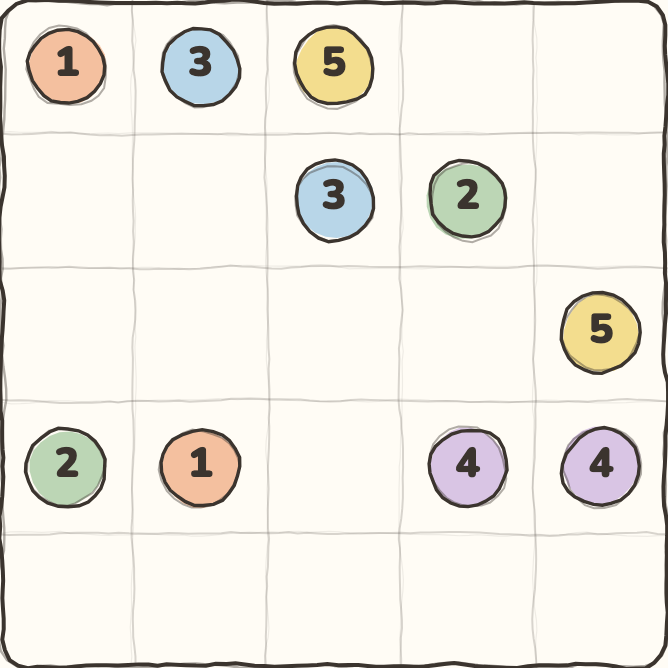
One hint
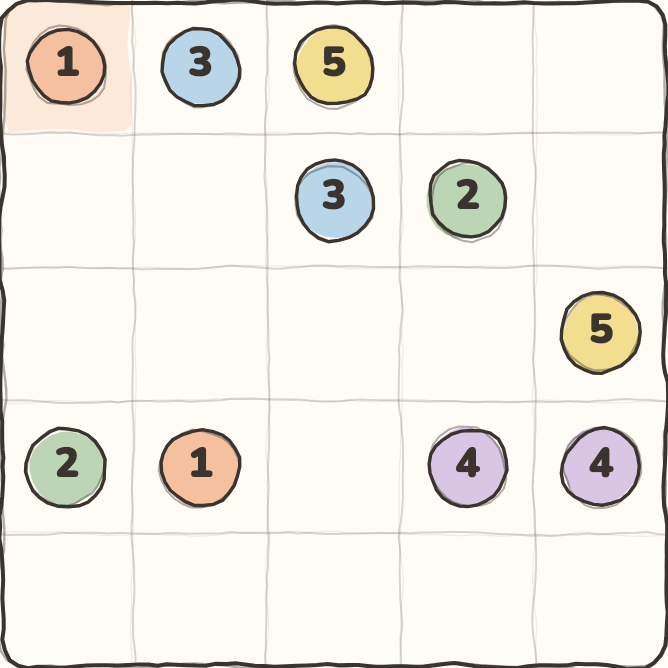
The game shows one next step.
Join the matching pairs
In Nimo's Routes, join each pair of matching numbers. Use one path for each pair. Go up, down, left or right. Do not go on a slant. Fill every square.
An ordinary square holds one path. Do not cross or branch there. Do not visit your own square twice. Do not pass through a different pair's end. A 3 must join the other 3. It does not mean the path must be three squares long.
Count the space each pair needs
Find a pair of matching numbers. Count the squares its shortest path would need, including both ends. Do the same for the other pairs.
Compare that count with the whole board. Every ordinary square can be used by only one path. A long detour may take space another pair needs.
Use the space count with care
If all the shortest paths already need every square, there is no space for a longer one. Each pair must use a shortest path that also leaves room for the rest.
If space is left over, a path may need to bend to fill it. So the shortest path is not always the answer. Check both the matching ends and all the blank squares.
Look at the space left over
A path end needs one way to go. A square inside a path needs a way in and a way out. A corner with no number has just two neighbours. The path must use both.
After drawing a path, check the space left over. Can the other pairs still meet? Can a path still reach each empty space? Change a path if it cuts off a pair or leaves a pocket that no path can fill.
Watch for bridges and portals
Nimo's level 0 lesson and help show how to draw a path. Some packs have bridges. Each has two straight lanes, across and up-and-down. Both lanes need different paths.
Some packs have portals. A path jumps from one portal to its pair. It then leaves beside that far portal. The special-rules guide explains both. At the end, trace each pair. Then look across each row for missed squares.