

One hint
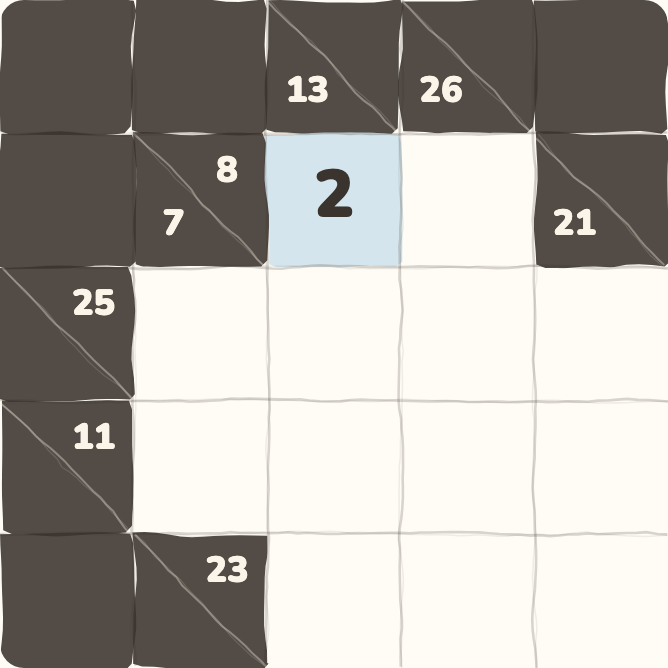
The game shows one next step.
Make the clue total
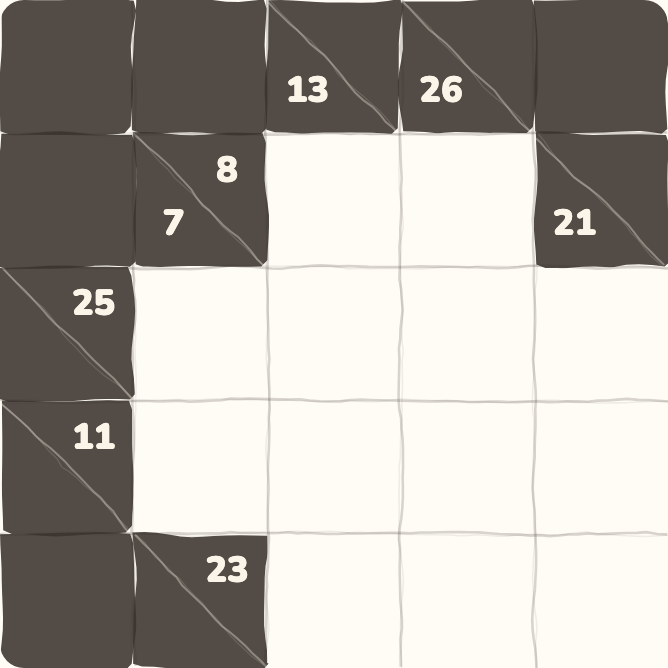
Kakuro is a number puzzle. Nimo calls it Sums. Fill white squares with 1 to 9. A clue gives the total for one line of white squares. That line is called a run. A dark square or the board edge ends it.
Do not use a number twice in one run. A total of 3 in two squares needs 1 and 2. The clue alone does not tell you which goes first.
Tap a white square in Nimo. Then pick a number. It must fit its across run and its down run. A number may appear elsewhere on the board. There is no rule to use every number in a whole row, as in Sudoku.
Find two clues for one square
Choose an empty white square. Find its across clue. Find its down clue too. Count how many squares belong to each run.
Start with short runs or totals with few choices. Do not put a group in order until the crossing clues help you choose.
Keep choices that fit both ways
A two-square total of 3 needs 1 and 2. A two-square total of 4 needs 1 and 3. It cannot use 2 twice.
If a square belongs to both of those runs, only 1 fits both lists. This is an example of using two clues together. On your board, compare the clues for the square you chose.
Check the sums and repeats
After a sure number, check its across run. Then check its down run. Each full run must make its clue total without a repeated number.
A 2 and a 2 add to 4. But they would break the no-repeat rule. Nimo shows when a full run matches. Still check the other run through each square.
Use the length and the total
Two squares that add to 17 must use 8 and 9. Three squares that add to 6 must use 1, 2 and 3. You know the numbers, but not yet their places. Check the runs that cross them.
After you place a sure number, take it away from the clue total. Do not use it again in that run. If the rest would need a repeat, that plan cannot work. Switch between across and down clues.